
collaboration
The only 5 rules you need to ace all your projects this year
Apply the SMART framework to everyday requests so ownership, scope, completion criteria, feasibility, and deadlines are clear.
Do colleagues misunderstand you and drive you crazy? You’re not alone. Communication makes or breaks projects, and often when the misunderstandings become clear, it’s already too late.
Research shows that 52% of all projects don’t deliver on their original goals - you can read exactly what typically goes wrong here.
In this article, we will show you how to avoid those mistakes and set your deliverables up for success. Every. Single. Time.
Applying the SMART technique correctly once and for all
The picture below shows a common email or Slack you’ve probably all received at some point - and it highlights everything that’s wrong with it.
“Hi Team, can some of you prepare the documentation for next week’s meeting ASAP? Thanks”
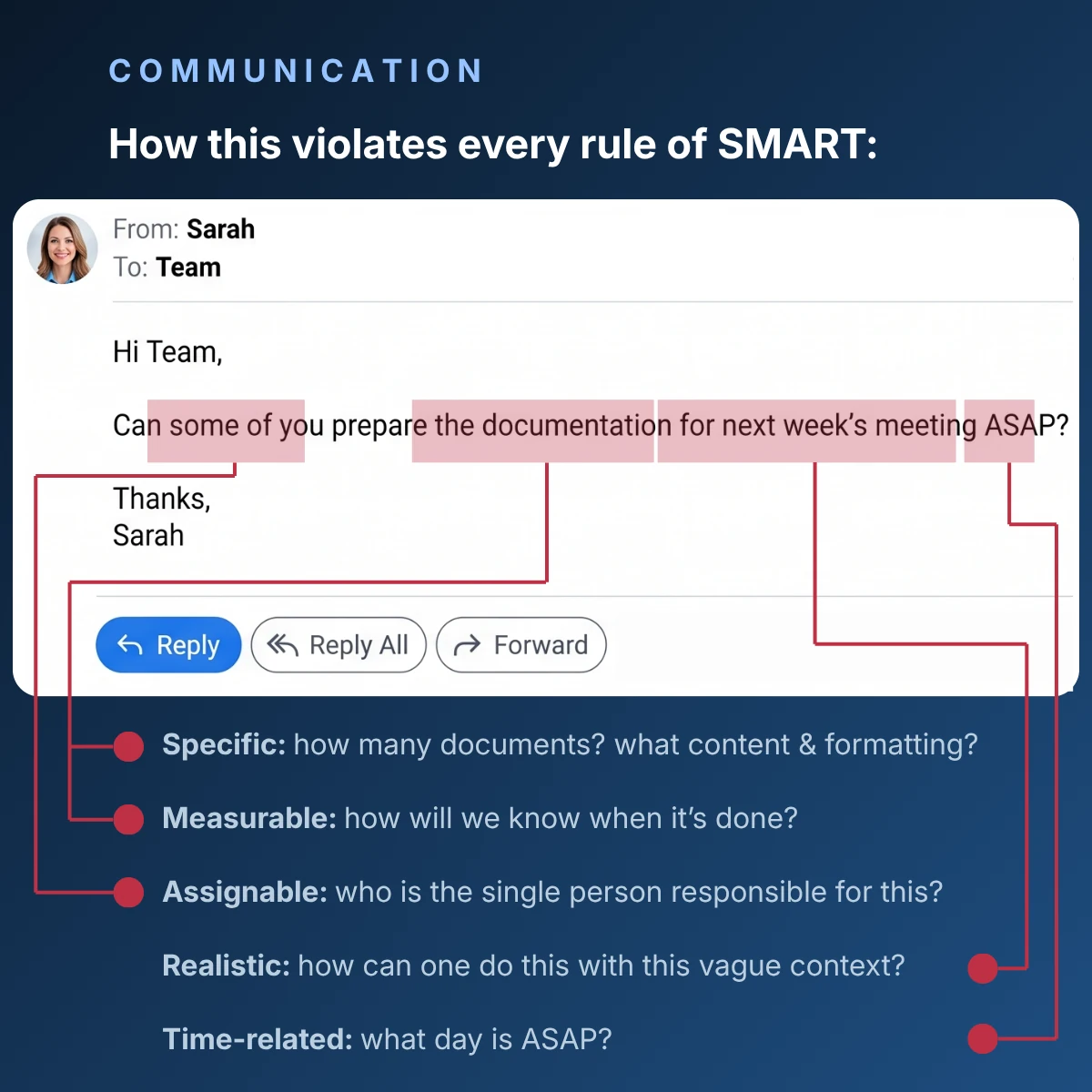
This message violates every principle of the oft-praised SMART framework (read here if you want a reminder). But how to make it right?
Let’s look at each letter of the framework in order:
1. Specific
What documents are needed? What should be the content and format of each?
Senders often think that, since they mentioned that the documents are for next week’s meeting, the answers to these questions “are obvious”. But evidence suggests that this lack of specificity is the single biggest cause of misunderstandings and mistakes.
Investing just 10 extra seconds up front spares you the pain, disappointment, and wasted time of reworking things at the last minute.
(If you want to know why horses help you always be Specific beyond all reasonable doubt, you can read this other article here - highly recommended!)
2. Measurable
“How do I know when I have completed this task?”
The answer to this question should be clear to the receiver and to anybody else looking at the task definition. In this case and many others, being “Specific” also beyond all reasonable doubt takes care of this aspect, too.

3. Assignable
There has to be only one owner, no exception. Asking “someone in the team” to do something doesn’t work because shared responsibility is no responsibility.
The sender should always pick just one person to ask. This principle always applies, even if:
- The task should be done by someone else; or
- It’s a complex deliverable that requires people to collaborate
The receiver can delegate to someone else, or even refuse to do the task (this other article talks about how to ensure you get commitment). But clarity is needed about who you will hold accountable for the task.
What about standardised company workflows whereby a ticket gets sent to a team (e.g. IT, marketing, etc)? Presumably, your company has assigned a specific person who is responsible for triaging these tickets - otherwise that process is broken.
4. Realistic
Because this is a hypothetical request, we don’t know the recipient’s workload. But in the real world, making a request ‘Realistic’ means checking two things before hitting send:
- Capacity - Does the recipient have the bandwidth this week? Or at least, does the request give enough notice for a reasonably busy person to reply to us before it’s due?
- Context - Does the recipient have the tools and information needed to do this?
5. Time-related
Always always always specify when is the latest possible deadline by which something is needed.
This needs to be a specific date and time. “ASAP” or “before I see you again” are not deadlines.
Pro tip: don’t set the deadline to the absolute last minute when you need something. You might need time to review what you’ve received. There might be additional steps needed before the output gets sent to other stakeholders and clients. Without being unrealistic (see point above), don’t live on the knife’s edge (unless that’s your kind of thing, of course…)
The Solution (🥁🥁🥁 drumroll please 🥁🥁🥁)
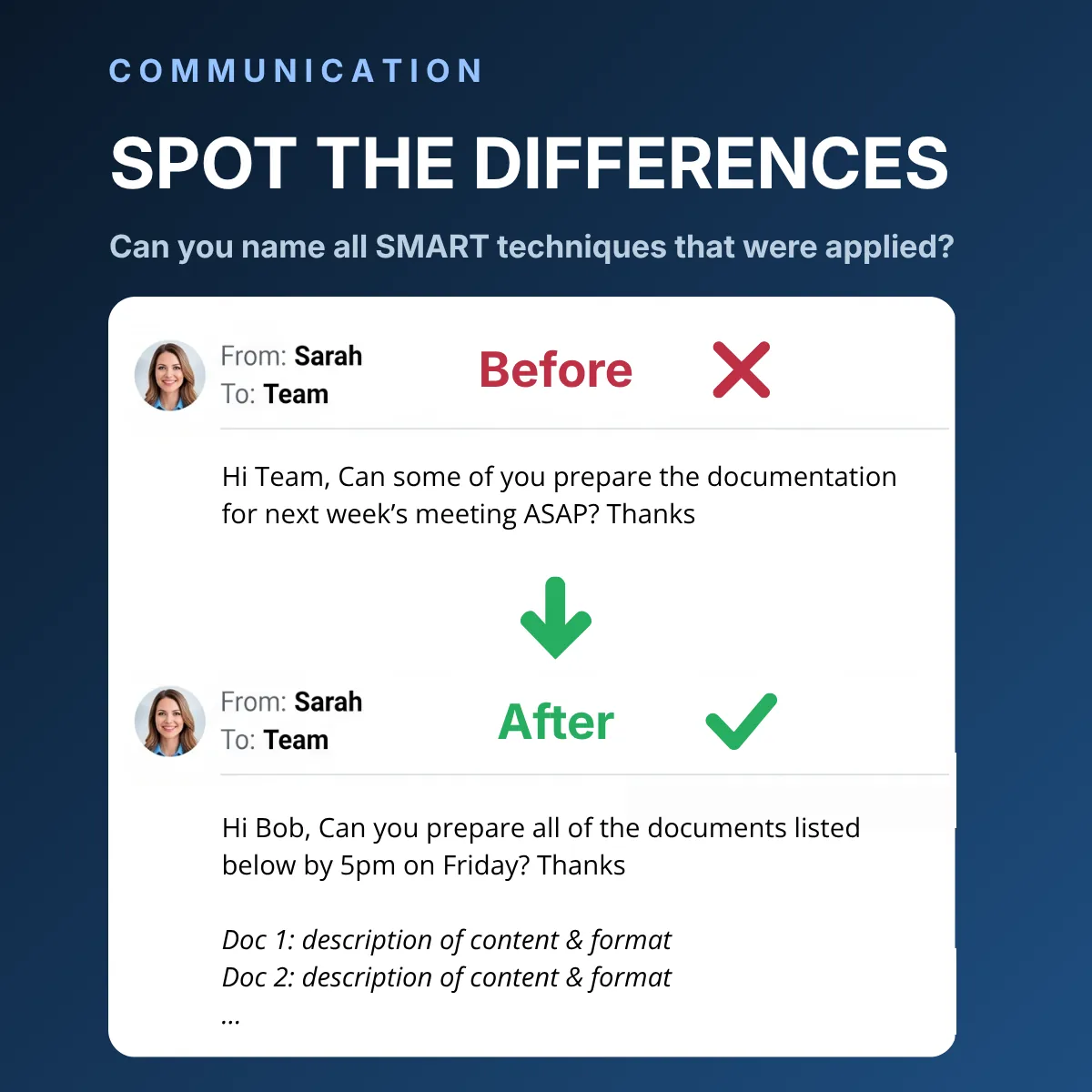
The “Before” (How we usually do it):
“Hi Team, can some of you prepare the documentation for next week’s meeting ASAP? Thanks”
The “After” (The 10-second SMART upgrade):
Check this for size:
“Hi Bob, can you prepare all of the documents listed below by 5pm on Friday? Thanks”
Doc 1: description of content & format
Doc 2: description of content & format
…
Why does this 10-second rewrite change everything? Let’s check the scorecard:
- Specific: the exact documents and formats are listed explicitly - no mind-reading required
- Measurable: Bob knows he is 100% done the moment those specific files are attached
- Assignable: it addresses a single person, Bob
- Realistic: assuming it isn’t sent at 3pm on Friday ;)
- Time-related: “5pm on Friday” leaves zero room for interpretation
Have we saved all of our projects forever? Almost, but not yet
Of course, there is one variable SMART goals can’t control: Bob.
What if he refuses? What if he pushes back on the deadline? Or worse, what if he fails to respond to the message?
Our next article shows you exactly how to handle these scenarios and make your projects’ timeline bulletproof.

Do you have a critical project you can’t afford to fail?
Let us help you get certainty, remove roadblocks, and deliver on time.
Get new best practices in your inbox
Broken processes drag down your work. Get our best techniques delivered to you regularly, so you can finish your projects on time and without the chaos.